Measuring success
When you start preparing any project, it’s a good idea to think about ways you can incorporate monitoring that will allow you to measure success at a point in the future.
Being able to measure the success of your project or plan will allow you to track progress against your overall objectives. This can be useful when reporting back to funders, as well as keeping project stakeholders and the wider community informed of what you have achieved.
Measuring success will help to evidence the impact of your project – which could be social, economic, or environmental – beyond just describing what you’ve done. Regular monitoring can also flag up areas where your project is underperforming and help to identify where further work is needed.
Evaluation Support Scotland has guidance and a range of free resources to help with measuring your project on its website.
This will depend on the nature of your project. It can be helpful to plot out how your project will achieve its impact. This starts with the inputs to a project, the activities that these inputs support, the immediate effects of these activities (outputs), and the eventual outcomes/impacts – as set out in this diagram.
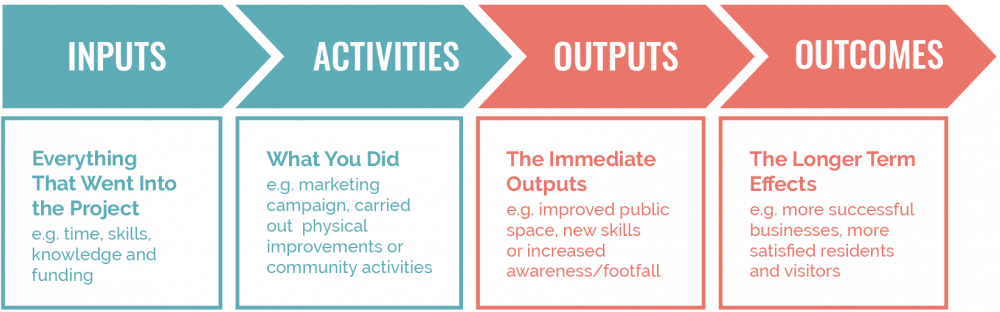
Once you’ve done this, it will be easier to think about the different elements of your project and to decide what is important to measure. Think about what success will look like, the objectives you are trying to achieve, and then how you can measure that. There’s often a tendency to focus on the inputs and activities – such as how much money you’ve spent – as this can be easier to capture, but try to show the lasting effects. These lasting effects are known as:
- Outputs – the things that were produced or created.
- Outcomes – the resulting impacts or benefits.
At a national level, the Scottish Government uses the National Performance Framework to track progress against outcomes, which set out an overall ambition for the country. These are measured through indicators – providing useful ideas for the kind of thing you can measure, as well as how you can align them with your outcomes. The full framework is under review and drafts of the updated framework can be found on the National Performance Framework website.
There are lots of different methods you can use for gathering evidence. Remember you are trying to show the change that has happened, so having a baseline in place – the position before your project started – will help with this.
You may be able to use data that is already collected or published by your own or another organisation, saving time and effort. Much of the published data relevant to towns is collated on STP’s Understanding Scotland’s Places website. The STP Your Town Audit also provides a framework for gathering additional information, like the town centre vacancy rate.
Some other useful sources include:
- Communities Channel Scotland has a useful section about evaluation and evidence of impact, with guidance and case studies – check out their ‘Show’ section, particularly targeted at local community organisations.
- The Scottish Public Health Observatory has detailed locality profiles, focused on health and wellbeing data, which are regularly updated. Coupled with towns data from USP provides a clear place profile.
- The National Lottery Heritage Fund have produced guidance on how you can link wellbeing to your project, and What Works Wellbeing has an interactive guide to measuring wellbeing.
- The Vacant and Derelict Land Survey records every urban vacant and derelict site in Scotland, and is updated each year.
- The Scottish Land Commission have produced guidance on assessing the benefits of bringing disused land back to life, and how to measure this.
See Gathering Information for more datasets that can help you bring together facts and figures for your town.
Surveys and focus groups are also useful tools, particularly for capturing perceptions and views on a project and the impact it has had on people.
There are also ways you can use monitoring on an ongoing basis to gather data about users and customers. Online advertising can be monitored and targeted appropriately through social media and data analytics across digital platforms. A loyalty card system can provide data on where and how people are spending money, allowing you to target promotions. Automatic footfall counters, whether on a street or at a venue or attraction, can provide a regular measure of how busy your town centre is (for more information on generating and using data about your town centre, see Go Digital).
An economic impact assessment (EIA) can measure your project’s contribution to the local, regional or national economy, such as the number of jobs created. This uses detailed data about direct and indirect spending associated with the project, so you may want to seek specialist help from an economic development consultant. This article from the Scottish Parliament Information Centre provides more information about what goes into an EIA.
Gaining validation from outside bodies is another way you can demonstrate what your project has achieved. It can help generate positive publicity for your project and keep momentum going. Having clear evidence that shows how you have improved your town centre, and the impact of your project, will be a big help if applying to an external scheme.
Examples included:
- Scotland Loves Local Awards: launched in 2021 by Scotland’s Towns Partnership, these awards highlight the people, places and projects which are leading the way in making a difference, making our communities cleaner, greener, stronger and fairer whether through design, delivery or sheer determination.
- SURF Awards: an annual awards process open to community regeneration projects in Scotland, with five categories. The awards have a particular focus on projects which have improved the wellbeing of individuals and communities. More information is on the SURF website.
- Scottish Awards for Quality in Planning: annual awards including a People’s Choice Award and other categories including children and young people, place, partnership, plans and process. More information can be found on the Scottish Government website here.
- Keep Scotland Beautiful: the charity run a number of awards and certificates that recognise community initiatives to improve their local environment, including the It’s Your Neighbourhood, Beautiful Scotland, and Green Flag Award initiatives. More details on the criteria and how to apply are here.
EXAMPLES OF MEASURING SUCCESS
Introducing a 20mph speed limit in Glasgow
In 2020, Glasgow City Council undertook an assessment of how well a 20mph speed limit was working in 82 areas where it had been implemented. This showed that there had been a 31% reduction in casualties on these streets – a measure of its success.
Using this evidence, they decided to standardise the 20mph speed limit on streets near houses and schools, in busy centres, or with a high level of pedestrian or cyclist use.
This is a good example of how the performance of an existing policy can be measured and, if deemed successful, used to guide further action.
Midsteeple Quarter, Dumfries
The Midsteeple Quarter project is a community-led response to improving Dumfries town centre through a business, culture, leisure and services-based approach.
The community is taking back control of a group of under-used and neglected buildings, and securing funding to refurbish and create a vibrant living, working, socialising, learning and enterprising quarter in the heart of Dumfries.
Following development of the Blueprint Strategy and Masterplan, an appraisal model was prepared that the team can use to test options as the project develops over the next 10-15 years. This model can be adapted for each stage of the project, allowing the team to measure how well it is contributing to the overall ambitions of the project – including the number of jobs supported, homes built, businesses accommodated, and vacant properties repurposed.
See the Inspiration section of this Toolkit for more information on Dumfries.
Cultural regeneration in Paisley
Although Paisley wasn’t successful in its bid to be UK City of Culture 2021, Renfrewshire Council and its bid partners were able to use the two-year campaign to galvanise support for the town’s culture-led regeneration strategy.
A new town vision and detailed action plan were put in place to build on this momentum, with an ambition of transforming Paisley into a vibrant cultural town centre by 2027. This includes measurable targets for achieving outcomes across a range of indicators, such as educational attainment, attendance at cultural events, digital connectivity, visitor numbers, and the condition of heritage buildings.
The broad range of measures will allow the local authority and its partners to assess how well the plan is performing across all of its different elements, helping to deliver a lasting legacy for the town.
As part of this, a Centre for Culture, Sport and Events has been set up in collaboration with the University of the West of Scotland. This will play a key role in measuring the town’s culture-led regeneration efforts, embedding expertise in the local area.
See the Inspiration section of this Toolkit for more information on Paisley’s journey.